
The tools exist. We rarely use them.
On the same things that break intentional communities, and the toolkits that usually stay on the shelf.

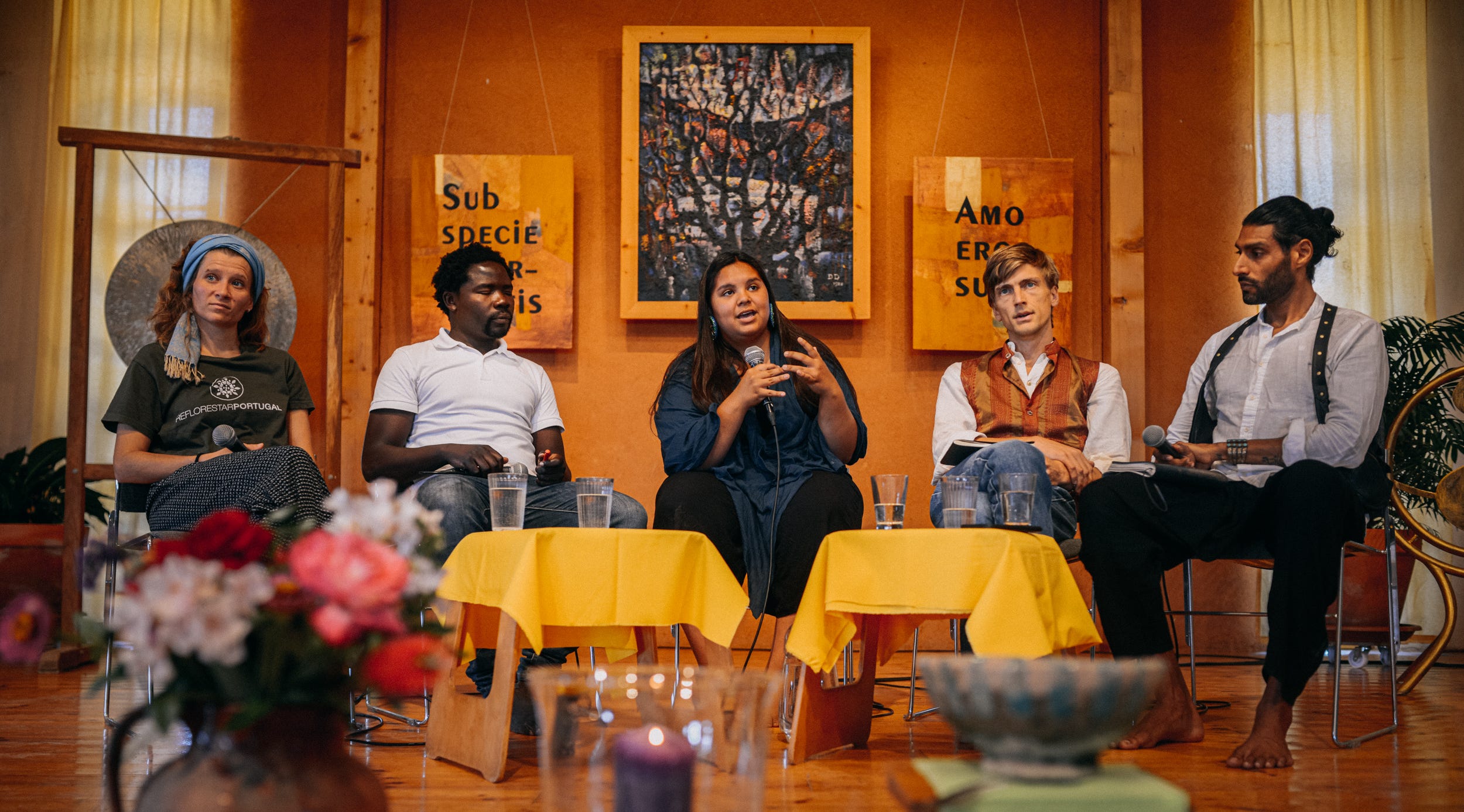
You know this scenario. You are sitting in a community meeting. There is tension in the room. Maybe it is a conflict nobody is sure how to resolve. Maybe it is a project everyone wants to move forward on, with no set culture for how the group decides what comes next. People throw out ideas. You cannot shake the feeling that this is not the best way to be doing this.
What I keep finding when communities fall apart is harder to write. The tools to prevent the collapse were there. Most of them were written down forty or fifty years ago. The people I have been sitting with in kitchen after kitchen had not heard of them.
That part has stayed with me through years of fieldwork. The problem is that the answer is already in a book or a constitution somewhere, and the people who need it are figuring it out from scratch.
The same things keep breaking
The two people I know who have spent the most time documenting why intentional communities fail are Diana Leafe Christian in the United States and Ilan Meyer in Israel-Palestine. They have never met. What they have found lines up in ways that are hard to explain unless what they describe is real.
Christian was the editor of Communities magazine for years before she wrote Creating a Life Together in 2003. The headline number from her rounds of interviews with intentional-community founders is one I cannot shake. Roughly 1 in 10 communities ultimately makes it. The survival data puts 80% of the failures inside the first two years. Christian’s diagnosis of why is specific. She names “structural conflict.” By that she means the absence of a clear decision-making structure before the first hard moment arrives.
Ilan has accompanied more than 40 kibbutzim through change processes. When I asked him what makes a community thrive, he answered in a single breath.
“In the end it comes back to three conditions. Growth. Dialogue of agreements. Leadership with trust. If all three exist the community can thrive. If one is missing cracks begin.”
— Ilan Meyer
Growth means roughly 25 new families every five years for a community of three to four hundred people. Without that, the kindergartens empty, the working-age population ages, the place can no longer carry itself. Ilan is precise about the number because he has watched it play out repeatedly.
Dialogue of agreements is what he calls an art. The capacity to put everything on the table, start with shared values before going to competing interests, then move toward compromise. Most communities lose this capacity the first time a real disagreement appears, and once it goes, decisions stop closing. Then trust starts to leak.
Leadership with trust is the condition he comes back to most. Legitimacy that comes from people believing the leader is not taking advantage of them. Authority can be assigned. Legitimacy has to be given. In communities that lasted, he keeps finding one or two people who held the center without claiming it. In communities that broke, he keeps finding the absence.
“When there is no trust there is no management. When there is no management nothing moves.”
— Ilan Meyer
Christian, working a continent and a generation away from Ilan, lands on the same picture from a different angle. She studies sociocracy now because the consensus-with-unanimity model most American communities inherited from the Quakers tends to collapse under sustained disagreement. One person says no, a year of work stops, trust erodes, leadership erodes, and growth stops. That is the same loop Ilan describes from inside the kibbutz world. The three failure modes feed each other.
Ilan told me about Kibbutz Samar in the Negev. Samar was unusual from the start. A group of people came out of the older kibbutzim in the 1970s and built a place that ran on personal responsibility instead of bureaucracy. Mutual responsibility without mechanisms. They shared everything, but they did not put a system in place to teach new arrivals how to share.
“Samar is like a ship with two decks. Above, parties. Below, those who row.”
— A Samar member, as told to Ilan Meyer
What you are reading is a diagnosis. Two people, working in different traditions on different continents, came to the same conclusion about what breaks a community. They named it in nearly the same words.
What has been on my mind since: the tools that address each of these failure modes already exist. Most of them have been written down for forty years or more. In the communities I have visited, it is rare to find any of them in active use.
Six things on the shelf
I want to walk you through six. Six tools that map onto the failure modes Ilan and Christian describe, drawn from a library I have spent the last year building.
Sociocracy 3.0
Is a modular consent-based decision system. It is what Christian recommends in place of traditional consensus, because it solves the single-veto collapse that kills the older model. The shift is small. Instead of asking the room “does anyone object,” you ask “is this good enough for now, safe enough to try.” A proposal passes when no one has a substantive objection grounded in the group’s stated aims. If you have ever sat in a four-hour meeting that ended with one person blocking the room, this is the first place I would point you.
Tamera Forum
If you read what I wrote a few weeks back you saw Forum at work in the field. The full framework, with its origins in the early 1970s and the structure of circle, center, and mirrors, sits in the library. Tamera has held a community in southern Portugal through more than forty years of partner conflict and leadership succession by sitting in the circle every week.
Liberating Structures
It is a toolkit of 33 microstructures developed by Henri Lipmanowicz and Keith McCandless. Each one is a small protocol you can drop into a meeting you are already running. 1-2-4-All. Troika Consulting. 25-10 Crowd Sourcing. The names sound like jargon until you try one. The point is structural. In a regular meeting the loudest person sets the floor. These microstructures change the floor without anyone having to call the loudest person out. Communities I have visited that started using them said the same thing back to me afterwards. Meetings shortened. Decisions started closing.
Lakabe: The Three-Step Decision Practice
Comes from an ecovillage of around fifty people in the Spanish Pyrenees, founded in 1980 by conscientious objectors who needed a way to decide things together without breaking each other. The practice they have refined over four decades is straightforward enough to take to your next meeting. For a hard decision, you do not try to settle it in one sitting. You split it across three meetings. The first is for what people feel about it. The second is for the logic. The third is for the impact on the community. Each meeting has its own permission and its own ban. You can be emotional in the first one without being told to stick to facts. You can argue logistics in the second without being told you are being cold. If your group has been stuck in the same argument for three months because the people who want to talk about feelings and the people who want to talk about money keep shouting past each other, this is the first practice I would try.
Circle / The Way of Council
It is what most groups are reaching for when they say they want to have “a real conversation.” A center, a rim of people, a talking piece that moves around so only the person holding it speaks, a guardian who watches the time and the energy. Three principles: speak from the heart, listen from the heart, be lean of expression. Three practices: spontaneous, slow, brief. You can run a first Council the day you read about it. It works for an eight-person shared house, an art collective in a residency, a temporary container at a festival, a 200-person ecovillage assembly. If you want one structural shift in your meetings without overhauling your governance, start a weekly Circle.
Dreamship Co-Ownership LLC Agreement
This model is what four families in Berkeley built when they decided to co-own a single home together. The unusual thing they did is publish the entire LLC operating agreement online as a downloadable template, so other groups can adapt it. It is one of the few cases in the Library where a working co-living constitution sits there as a document you can open in Word. If you are a friend group thinking about buying a property, an art collective formalizing a studio lease, or a small intentional community trying to figure out who owns what when someone leaves, this is the starting document. It will save you months of figuring out from scratch what someone else has already solved.
What I have been building
For years, I have been doing field interviews across intentional communities around the world. The pattern I kept hearing was strange. Communities had often, without knowing it, reinvented something close to Lakabe’s three-step practice, or stumbled into a decision structure that looked like Sociocracy. Some had built versions of Council without having ever heard of Council. They did the work themselves because the work they needed was already in writing somewhere they had no time to look for.
The Living Library is where I park what already works.
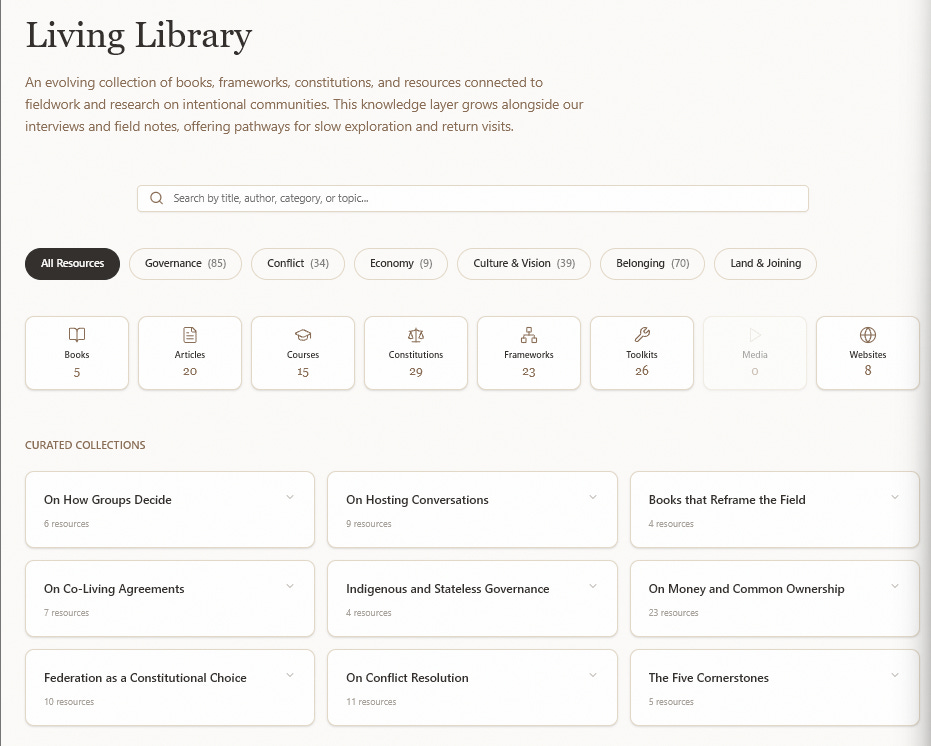
It currently holds 126 entries. Frameworks for dialogue and decision making. Constitutions from communities that have held themselves together for decades or centuries. Books that turned out to matter. Toolkits that came out of one place and turned out to work in others. Each entry is a real document with the original voice intact, a link back to the community or thinker the practice came from, and these are methods I’ve practiced or witnessed myself that make a difference. You can read it in the order it was built, or click through by theme.
People sometimes ask me how the interviews and the tools relate. In my early field visits, they did not relate. I came back with stories. Then I started seeing the same shapes repeat across communities and started looking for whether the shape had been named before. Almost always it had been. Now, when I sit with a community in their kitchen, the question I am holding is whether the failure mode they are describing has already been named somewhere. Most of the time it has. The Library is a place to keep the answers, so the next conversation can start with a tool instead of a re-derivation.
If you have read this far and you are thinking about your own community, your ecovillage, your shared house, your art collective, your seasonal container, here is what I would do. Pick one of the three failure modes Ilan names that you recognize in your own place. Pick one tool from the Library that addresses it. Try it for six weeks before you decide whether it works.
Treat the Library as a shelf. Take one thing off at a time.
You can browse it at togatherproject.eu/library.
If this landed with you
If something in this piece landed with you, I want to hear about it. Reply here, or find me through the archive at togatherproject.eu. This is field research, and the best field research is a conversation.
If you know someone who is sitting in a kitchen right now, figuring out how their community is going to make a hard decision, share this with them. That is exactly who this is for.
And if you want to support more of this fieldwork, more interviews, more honest documentation of what actually happens when people try to live together, ToGather is currently running a campaign on Artizen.
ToGather is a field research archive documenting how intentional communities around the world govern themselves, coordinate resources, and navigate conflict. The archive holds interviews from communities across Europe, the Middle East, and India. Full archive: togatherproject.eu
thank you for documenting all of this valuable data and stories. specifically about Kibutzim I’d like to add that unlike many other forms of voluntary forms of communal organization, they are a part a much bigger project of Zionist settler colonialism and its goals were never common living but the erasure of Palestinians while presenting a green washed socialist facade. I’m sure many people who joined them joined with genuine idealistic goals in mind but this is a systemic data point that can’t be separated from a study of why they all failed almost entirely. Perhaps more can be said more largely of the effects of trying to build communities under capitalism or in other stolen lands around the world.